
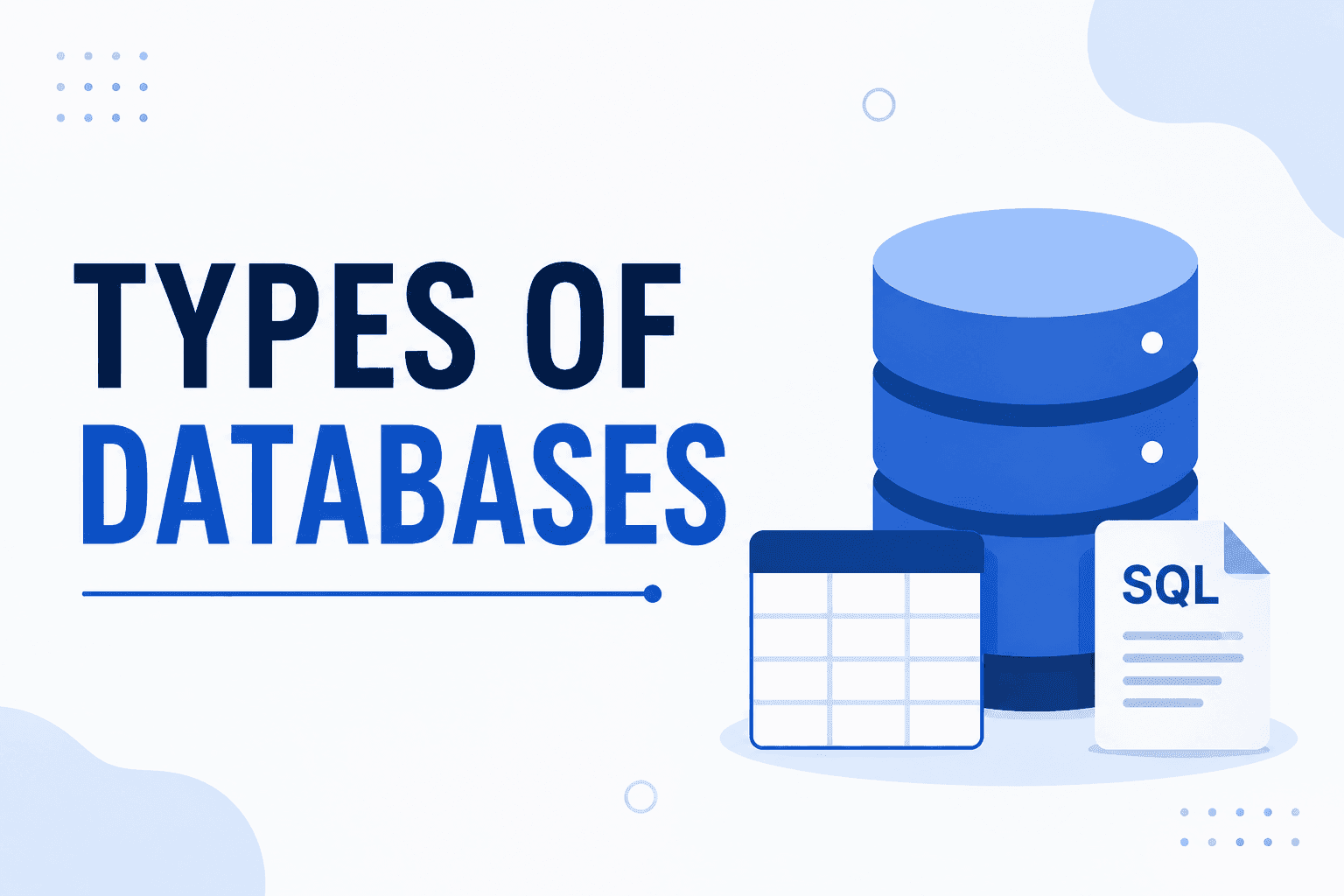
Types of Databases
Types of Databases :
Every app needs a place to store data users, products, messages, orders, anything. That storage place is called a database. But not all databases work the same way, and picking the right type actually matters a lot once your app grows. Let's break down the main types in a simple way, with real examples.
The Two Big Families
There are two main types of databases:
- SQL databases (also called relational databases)
- NoSQL databases (non-relational databases)
Almost everything else you'll hear about fits under one of these two families. Think of it like this: SQL is like a well-organized filing cabinet with labeled folders. NoSQL is like a flexible storage box where you can throw in items of different shapes and sizes.
1. SQL Databases (Relational)
SQL databases store data in tables like a spreadsheet with rows and columns. Every table has a fixed structure, meaning you decide the columns upfront, and every row must follow that same structure.
Example: MySQL, PostgreSQL, Oracle, SQLite
Simple example table (Users):
| id | name | |
|---|---|---|
| 1 | NAGA | [email protected] |
| 2 | BABU | [email protected] |
Now imagine you also have an Orders table:
| order_id | user_id | product |
|---|---|---|
| 101 | 1 | Laptop |
| 102 | 2 | Phone |
Notice the user_id column — it connects Orders back to Users. This connection between tables is called a relationship, which is exactly why these are called "relational" databases.
Good for: Apps where your data has a clear structure — like a school system, banking app, hospital records, or online store. Basically, anywhere data needs to stay accurate and organized.
2. NoSQL Databases (Non-Relational)
NoSQL databases don't use fixed tables. They store data in more flexible formats, which makes them great when your data doesn't fit neatly into rows and columns, or when you're dealing with huge amounts of data spread across many servers.
There are 4 common types of NoSQL databases:
a) Document Databases
Stores data like a JSON file — a flexible, readable format. Two records don't even need to have the same fields.
Example: MongoDB, CouchDB
{
  "name": "Nani",
  "course": "Python Full Stack",
  "skills": ["Python", "FastAPI", "Django"]
}
Good for: Apps where data structure changes often, like user profiles, blogs, or product catalogs where every item has slightly different details.
b) Key-Value Databases
The simplest type of all — just a key and a value, like a dictionary or a locker system where each locker (key) holds one item (value).
Example: Redis, DynamoDB
Simple example:
| Key | Value |
|---|---|
| user_session_123 | {loggedIn: true} |
| cart_count_45 | 3 |
Good for: Fast, temporary data like login sessions, shopping cart counts, or caching — anything that needs to be read and written in milliseconds.
c) Column-Family Databases
Stores huge amounts of data efficiently, organized by columns instead of rows. This makes reading and writing large volumes of data across many computers much faster.
Example: Cassandra, HBase
Good for: Big data applications — things like tracking millions of sensor readings, analytics dashboards, or large-scale logging systems.
d) Graph Databases
Stores data as connections — like a network of dots (called nodes) linked by lines (called edges). Perfect for data that's naturally about relationships.
Example: Neo4j
Good for: Social media apps ("who follows who"), recommendation systems ("people you may know" or "you might also like"), and fraud detection (spotting unusual connections between accounts).
SQL vs NoSQL — Quick Comparison
| SQL | NoSQL | |
|---|---|---|
| Structure | Fixed (tables) | Flexible |
| Easy for beginners? | Yes | Yes, but different mindset |
| Best for | Structured, related data | Changing or huge-scale data |
| Scaling | Usually one powerful server | Spreads across many servers easily |
| Examples | MySQL, PostgreSQL, Oracle | MongoDB, Redis, Cassandra |
A Simple Way to Decide
Ask yourself:
- Does my data have clear categories and relationships (like Users, Orders, Products)? → Go SQL.
- Does my data change shape a lot, or grow massively fast? → Go NoSQL.
- Am I just starting to learn databases? → Start with SQL — it teaches the fundamentals every developer needs.
Many real apps actually use both — SQL for the main structured data, and something like Redis for fast caching on top. They're not competitors; they just do different jobs well.
Simple Takeaway
- SQL = data in neat tables, fixed structure, great for beginners and structured apps.
- NoSQL = data in flexible formats, great for apps that change a lot or scale fast.
- Most beginners should start with SQL, then branch into NoSQL later.
Comments