

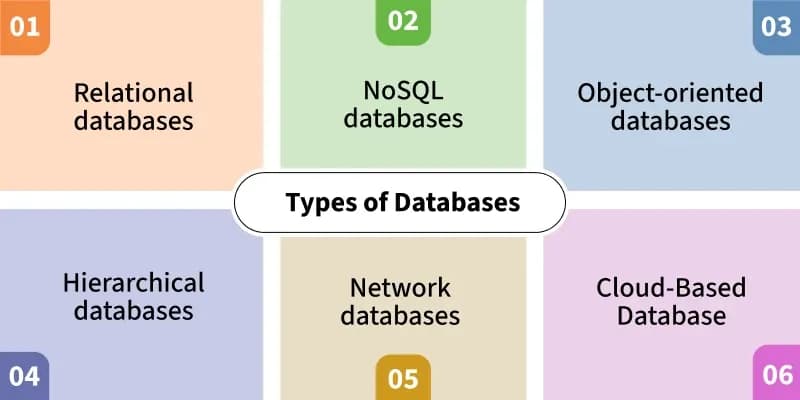
Types of Databases
Key Feature: They enforce strict data integrity and rely on Structured Query Language (SQL).
Best For: Financial systems, inventory management, and CRM applications.
Popular Examples: MySQL, PostgreSQL, and Oracle Database.
Sub-types Include:
Document Databases: Store data in flexible JSON-like documents (e.g., MongoDB).
Key-Value Stores: Simple, ultra-fast databases that store data as pairs (e.g., Redis).
Wide-Column Stores: Organize data in columns rather than rows for heavy analytic queries (e.g., Apache Cassandra).
Best For: Real-time analytics, content management, and IoT applications.
Best For: Web and mobile applications with fluctuating workloads.
Popular Examples: Amazon RDS, Azure SQL Database, and Google Cloud Spanner.
Best For: Social networks, fraud detection, and recommendation engines.
Popular Examples: Neo4j and Amazon Neptune.
Best For: IoT sensor data monitoring, financial trading algorithms, and system performance metrics.
Popular Examples: InfluxDB and TimescaleDB.
Best For: Real-time applications like gaming leaderboards and high-frequency trading.
Popular Examples: Redis and Memcached.
Comments