

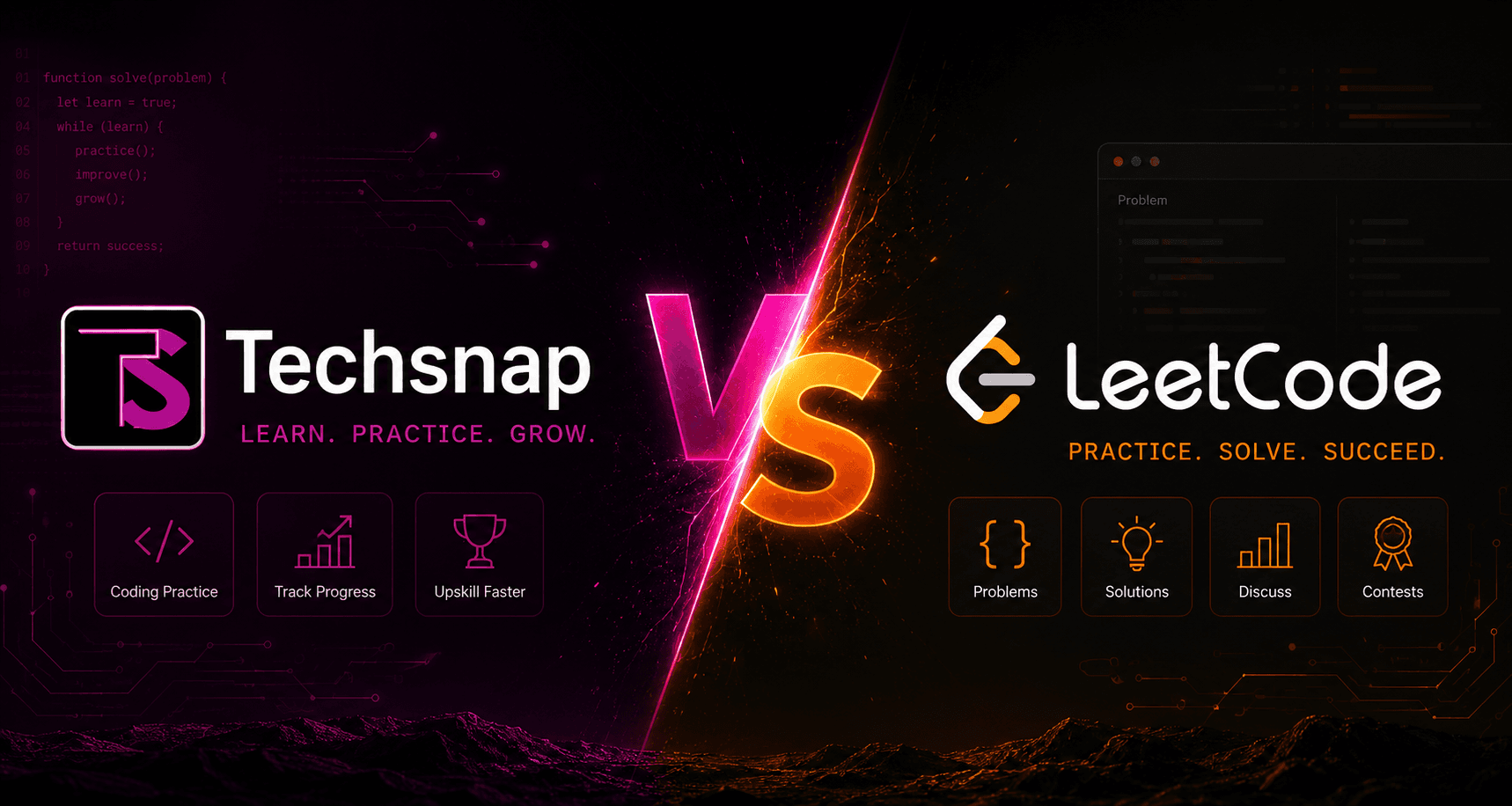
Techsnap vs LeetCode: Real Full-Stack Projects vs Memorizing Syntax
The Tech Industry No Longer Rewards Memorization Alone
For years, students followed the same path:
- Solve LeetCode problems
- Memorize patterns
- Grind coding questions
- Chase interview preparation streaks
And for a long time, it worked.
But in 2026, the technology industry has evolved far beyond syntax memorization and coding pattern repetition.
Today’s companies want developers who can:
- Build scalable applications
- Understand real systems
- Work with AI tools
- Deploy production-ready software
- Collaborate with teams
- Solve actual business problems
This is where the difference between Techsnap and traditional coding-focused platforms becomes impossible to ignore.
LeetCode Builds Problem Solvers
But Modern Companies Need Builders
LeetCode is undeniably useful for:
- Data structures and algorithms
- Technical interview preparation
- Logic building
- Pattern recognition
- Coding confidence
Students preparing for product-company interviews still benefit from LeetCode-style learning.
But there is a growing issue across the industry.
Solving Questions Is Not the Same as Building Products
Many students become experts at:
- Binary trees
- Dynamic programming
- Sliding window problems
- Syntax optimization
Yet struggle when asked to:
- Build APIs
- Design databases
- Deploy cloud applications
- Create authentication systems
- Optimize frontend performance
- Integrate AI workflows
- Work in production environments
That gap is becoming one of the biggest hiring challenges in modern technology ecosystems.
The Rise of Full-Stack Thinking
Companies Want Developers Who Understand Systems
In 2026, software engineering is no longer isolated coding.
Modern development includes:
- Frontend systems
- Backend architecture
- Cloud deployment
- AI integrations
- DevOps workflows
- Database optimization
- Product thinking
Recruiters increasingly prefer candidates with:
- GitHub portfolios
- Live applications
- SaaS products
- Open-source contributions
- Technical blogs
- Innovation projects
Because real-world engineering demonstrates:
- Problem-solving
- Scalability thinking
- Creativity
- Debugging ability
- Collaboration skills
This is where Techsnap positions itself differently.
Techsnap Is Built for the AI Era
Not Just for Coding Interviews
Unlike traditional interview-focused platforms, Techsnap is designed as a technology super app for:
- Students
- Developers
- Universities
- Innovation ecosystems
- Startup communities
The focus is not simply:
“Can you solve coding questions?”
The focus becomes:
“Can you build technology people actually use?”
That shift changes everything.
Why Full-Stack Projects Matter More in 2026
Real Projects Create Real Engineers
A full-stack project teaches students:
- Architecture decisions
- API handling
- Database management
- Authentication systems
- Deployment pipelines
- Error handling
- Performance optimization
- Team collaboration
These are skills companies cannot measure through coding questions alone.
Example:
A student building:
- An AI-powered SaaS dashboard
- A smart campus application
- A student management platform
- A real-time chat application
learns far more practical engineering than someone memorizing 500 coding patterns without implementation experience.
Techsnap vs LeetCode: The Difference

Why Universities Are Also Shifting
Traditional Learning Models Are Becoming Outdated
Universities are realizing that:
- Marks alone are insufficient
- Coding ratings alone are insufficient
- Memorization-based learning is insufficient
Modern education now requires:
- Technology-driven student growth
- Innovation ecosystems
- Real-world exposure
- Industry collaboration
- AI-powered learning systems
This is where Techsnap and ManageSnap become highly relevant.
ManageSnap: The Infrastructure Layer Behind Smart Campuses
Beyond Traditional ERP Systems
Most university systems only track:
- Attendance
- Marks
- Semester data
ManageSnap goes much further.
It provides end-to-end student lifecycle management from Semester 1 to final placements.
The platform tracks:
- Skills
- Projects
- Coding growth
- Certifications
- Internships
- Hackathons
- Resume progress
- Placement readiness
- Innovation activities
- Technical development
This transforms universities from:
academic institutions
into
technology-driven innovation ecosystems.
The AI Revolution Changed Hiring Forever
AI Can Write Syntax — But Not Build Vision
Modern AI tools can now generate:
- Boilerplate code
- CRUD operations
- Simple algorithms
- UI templates
This means syntax memorization alone is rapidly losing value.
What still matters is:
- System thinking
- Product understanding
- Creativity
- Architecture decisions
- Business problem-solving
That’s why companies increasingly prioritize:
- Builders
- Innovators
- Full-stack developers
- Product-minded engineers
Instead of pure interview grinders.
The Biggest Mistake Students Still Make
Learning Only for Interviews
Many students spend:
- Months memorizing patterns
- Hundreds of hours solving repetitive problems
- Entire semesters preparing only for interviews
But never build anything real.
This creates a dangerous skill imbalance.
The Better Strategy in 2026:
- Learn DSA fundamentals
- Build real-world applications
- Deploy projects publicly
- Learn AI-assisted workflows
- Participate in innovation communities
- Create a visible portfolio
This is exactly the direction Techsnap promotes.
The Future Belongs to Builders
Technology Is Moving Toward Ecosystems
The next generation of developers will not be judged only by:
- Ratings
- Contest scores
- Syntax speed
They will be evaluated based on:
- Real impact
- Technical depth
- Innovation capability
- Product execution
- Ecosystem contribution
Techsnap is positioning itself around this future.
Not just as a platform.
But as a connected technology ecosystem for:
- Students
- Developers
- Universities
- Startups
- Innovation communities
Final Thoughts
LeetCode still has value.
Coding interviews still matter.
But the future of technology belongs to developers who can:
- Build products
- Solve business problems
- Create scalable systems
- Work across full stacks
- Adapt to AI-driven workflows
The industry is shifting from:
memorizing syntax
to
building meaningful technology.
And that is exactly where Techsnap is leading the next generation.
FAQ Section
Is LeetCode enough to get a software job in 2026?
No. LeetCode helps with coding interviews, but companies increasingly evaluate project experience, system understanding, deployment skills, and real-world engineering ability.
Why are full-stack projects important?
Full-stack projects help developers learn architecture, deployment, APIs, databases, debugging, and scalability — all critical skills in modern software engineering.
What makes Techsnap different from LeetCode?
LeetCode focuses mainly on interview preparation, while Techsnap focuses on real-world technology ecosystems, innovation, project building, AI-era skills, and industry readiness.
How does ManageSnap help universities?
ManageSnap helps universities track the complete student journey from Semester 1 to placements, including projects, internships, skills, certifications, and innovation activities.
What skills should developers focus on in 2026?
Developers should focus on:
- Full-stack development
- AI integrations
- System design
- Cloud deployment
- Product thinking
- Real-world projects
- Communication and collaboration
Comments