

#pythonoperators#python
Operators in Python – Part 1
Operators are symbols used to perform different operations on values and variables. In this first part, we'll look at arithmetic, comparison, and assignment operators.
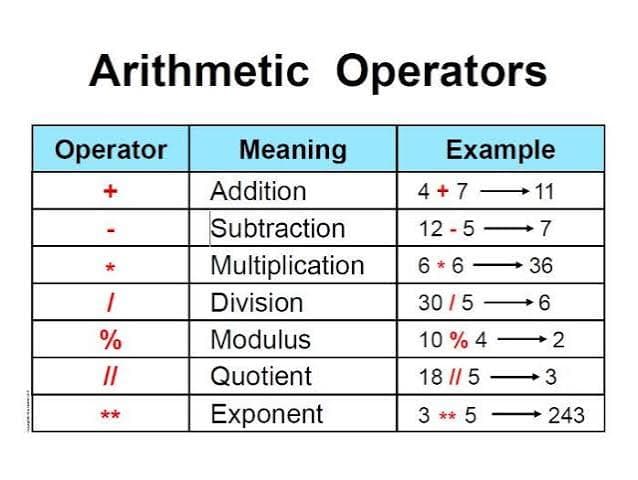
Arithmetic Operators
Arithmetic operators are used for basic mathematical calculations.
a = 10
b = 3

print(a + b)
print(a - b)
print(a * b)
print(a / b)
Output:
13
7
30
3.3333333333333335
Common arithmetic operators are:
| Operator | Meaning |
|---|---|
+ | Addition |
- | Subtraction |
* | Multiplication |
/ | Division |
% | Remainder |
** | Power |
// | Floor division |
Comparison Operators
Comparison operators are used to compare two values. The result is either True or False.
a = 10
b = 5

print(a > b)
print(a == b)
print(a != b)
Output:
True
False
True
Some common comparison operators are:
==, !=, >, <, >=, <=
Assignment Operators
Assignment operators are used to store or update values in variables.
x = 10

x += 5

print(x)
Output:
15Common assignment operators include =, +=, -=, *=, and /=.
Comments