

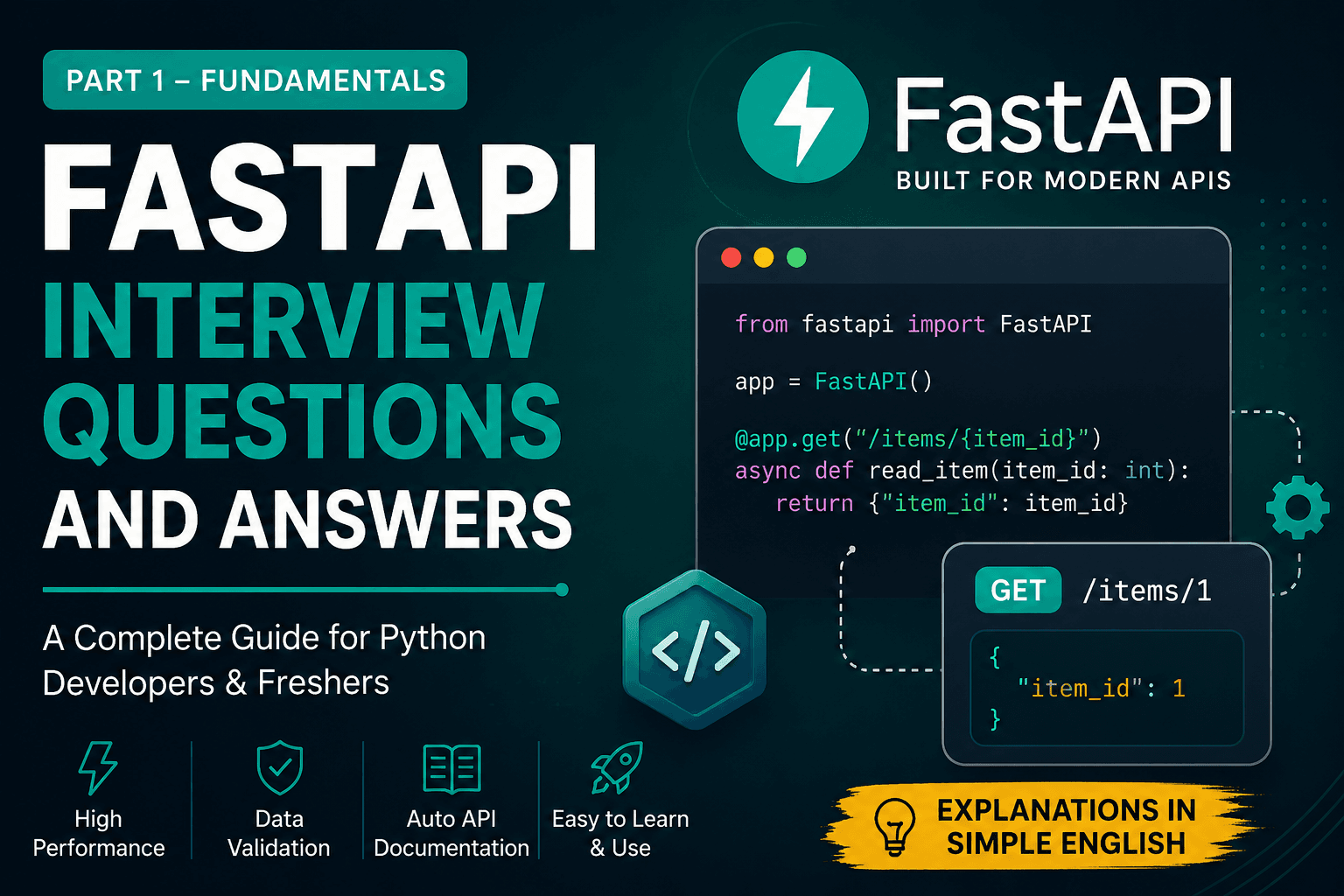
FastAPI Interview Questions and Answers: Part 1 — Fundamentals
FastAPI Interview Questions and Answers: Part 1 — Fundamentals
FastAPI is a Python framework used to build APIs. If you are preparing for a Python or Full Stack Developer interview, it is not enough to remember what FastAPI stands for. You should understand what happens when a request reaches your API, how FastAPI validates data, and how an endpoint is created.
This article covers the fundamental FastAPI questions that are commonly asked in interviews.
1. What is FastAPI, and what are its key features?
FastAPI is a Python web framework used to build APIs.
Think of an API as a waiter in a restaurant.
You tell the waiter what you want, the waiter takes your request to the kitchen, and then brings the result back to you.
In the same way:
Client
   ↓
FastAPI
   ↓
Business Logic
   ↓
Database
   ↓
FastAPI
   ↓
Client
FastAPI helps us create the part that receives requests and sends responses.
Key features of FastAPI
1. Automatic data validation
FastAPI can check whether the data sent by the client has the correct type and structure.
For example, if an API expects:
age: int
and the client sends:
age = "hello"
FastAPI can detect that the value is not an integer.
2. Asynchronous programming
FastAPI supports async and await, which are useful when an application spends time waiting for things such as database or network operations.
3. Automatic API documentation
FastAPI automatically creates interactive API documentation from your routes and data models.
4. Dependency Injection
FastAPI provides Depends() to reuse common logic such as database connections and authentication.
5. Type hints
FastAPI makes heavy use of normal Python type hints.
For example:
def get_user(user_id: int):
    ...
Here, int tells FastAPI that user_id should be an integer.
So, in simple words:
FastAPI helps us build APIs quickly while giving us validation, documentation, type checking and other useful backend features.
2. Compare FastAPI with Flask and Django REST Framework.
All three can be used to build APIs, but they are designed differently.
FastAPI
FastAPI is designed with modern API development in mind.
It provides:
- Automatic validation
- Automatic API documentation
- Type-hint based development
- Support for asynchronous programming
- Dependency Injection
Flask
Flask is a lightweight and flexible Python web framework.
It gives developers a small core and lets them choose additional libraries for things such as validation, database access and authentication.
Django REST Framework
Django REST Framework, commonly called DRF, is built on top of Django.
Django already provides many features for building large web applications, including:
- ORM
- Authentication
- Admin interface
- Database management
DRF adds tools for creating APIs on top of Django.
Simple comparison
| Feature | FastAPI | Flask | Django REST Framework |
|---|---|---|---|
| API development | Excellent | Yes | Excellent |
| Async support | Strong | Available depending on setup | Available, but Django has broader architecture |
| Automatic validation | Built in through Pydantic | Usually additional libraries | Serializers |
| Automatic API docs | Built in | Usually additional tools | Additional tools commonly used |
| Built-in ORM | No | No | Yes, through Django |
| Built-in Admin | No | No | Yes, through Django |
There is no framework that is automatically the best for every project.
The choice depends on what the application needs.
3. How does FastAPI automatically generate OpenAPI (Swagger) documentation?
Imagine that you have to write a manual instruction book for your API.
You would need to write:
Endpoint: /users
Method: GET
Input: user_id
Output: User data
FastAPI can generate much of this information automatically.
When you write:
from fastapi import FastAPI

app = FastAPI()

@app.get("/users/{user_id}")
def get_user(user_id: int):
    return {"user_id": user_id}
FastAPI can understand:
- The endpoint is
/users/{user_id} - The method is GET
user_idis an integer- The endpoint returns data
FastAPI uses this information to create an OpenAPI schema.
That schema can then be displayed through interactive documentation.
Swagger UI
Usually available at:
/docs
It allows you to see the API and even send requests from the browser.
ReDoc
Usually available at:
/redoc
It provides another documentation interface for reading the API structure.
So:
OpenAPI is the specification describing the API, while Swagger UI is an interactive interface that can display and test that API.
4. What is Pydantic, and why is it integral to FastAPI?
Pydantic is a Python library used for data validation and data parsing.
Think about a school form.
The form may say:
Name → Text
Age → Number
Email → Valid email
If someone enters incorrect information, the form should complain.
Pydantic does something similar for API data.
Example:
from pydantic import BaseModel

class User(BaseModel):
    name: str
    age: int
This model tells FastAPI:
name → should be a string
age  → should be an integer
Now an API can use this model:
@app.post("/users")
def create_user(user: User):
    return user
When the client sends data, FastAPI uses the Pydantic model to check it.
Why is this useful?
Without validation, we might have to manually check every field:
if not isinstance(name, str):
    ...

if not isinstance(age, int):
    ...
Pydantic reduces this repetitive work.
It also helps FastAPI understand the structure of request and response data, which contributes to the generated API documentation.
So the simple idea is:
Pydantic acts like a strict form checker for the data entering and leaving your API.
5. What is Starlette, and how does FastAPI build upon it?
This is a slightly deeper question.
FastAPI does not build everything completely from scratch.
It uses Starlette as one of its foundations.
Starlette provides important web functionality such as:
- Routing
- Request handling
- Response handling
- Middleware
- WebSockets
- Background task support
FastAPI adds higher-level features on top of this foundation.
For example:
                 FastAPI
        ┌─────────────────────┐
        │ Pydantic validation │
        │ Dependency Injection│
        │ API documentation   │
        │ Type hints          │
        └──────────┬──────────┘
                   ↓
               Starlette
        ┌─────────────────────┐
        │ Routing             │
        │ Middleware          │
        │ Requests/Responses  │
        │ WebSockets          │
        └─────────────────────┘
                   ↓
                  ASGI
You can think of Starlette as part of the lower-level web foundation, while FastAPI gives developers a more convenient API-development experience on top of it.
6. What are path operations in FastAPI?
A path operation tells FastAPI:
"When this HTTP method is requested at this URL, run this function."
For example:
@app.get("/users")
def get_users():
    return {"users": []}
Here:
GET + /users
is the path operation.
The function:
get_users()
is executed when that request reaches the application.
The word path refers to the URL path:
/users
/products
/orders
The word operation refers to the HTTP operation:
GET
POST
PUT
DELETE
So:
A path operation connects an HTTP method and a URL path to a Python function.
7. Discuss different types of path operations (GET, POST, PUT, DELETE, etc.)
FastAPI supports the common HTTP methods.
GET
Used mainly to retrieve data.
@app.get("/users")
def get_users():
    return {"users": []}
Think:
"Give me the users."
POST
Used commonly to create a new resource or submit data.
@app.post("/users")
def create_user():
    return {"message": "User created"}
Think:
"Create a new user."
PUT
Used to replace or update a resource.
@app.put("/users/1")
def update_user():
    return {"message": "User updated"}
Think:
"Replace/update this user."
PATCH
Used when only part of a resource needs to be updated.
@app.patch("/users/1")
def update_user_name():
    return {"message": "Name updated"}
Think:
"Change only this part."
DELETE
Used to remove a resource.
@app.delete("/users/1")
def delete_user():
    return {"message": "User deleted"}
Think:
"Remove this user."
A simple way to remember them:
GET     → Read
POST    → Create
PUT     → Replace/Update
PATCH   → Partial Update
DELETE  → Delete
8. Demonstrate how to create a path operation using FastAPI.
First, create a FastAPI application:
from fastapi import FastAPI

app = FastAPI()
Then create a path operation:
@app.get("/items/{item_id}")
async def read_item(item_id: int):
    return {"item_id": item_id}
Now suppose the client sends:
GET /items/10
FastAPI sees:
/items/{item_id}
and extracts:
item_id = 10
Because we wrote:
item_id: int
FastAPI knows that the value should be an integer.
The response will be:
{
    "item_id": 10
}
The important pieces are:
@app.get(...)
     ↓
URL path
     ↓
Python function
     ↓
Response
9. What are path parameters and query parameters in FastAPI? How do you define them?
Both are ways of sending information to an API, but they are used differently.
Path parameter
A path parameter is part of the URL itself.
Example:
/users/25
Here 25 can represent the user's ID.
FastAPI:
@app.get("/users/{user_id}")
def get_user(user_id: int):
    return {"user_id": user_id}
Here:
{user_id}
is the path parameter.
Query parameter
A query parameter comes after ?.
Example:
/users?limit=10
FastAPI:
@app.get("/users")
def get_users(limit: int = 10):
    return {"limit": limit}
Here limit is a query parameter.
When do we use each one?
Path parameter:
/users/25
Usually identifies which resource we want.
Query parameter:
/users?limit=10
Usually changes how we want the data.
For example:
/products?category=shoes
/products?limit=20
/products?search=phone
So the easiest way to remember:
Path parameter → Which thing?
Query parameter → How do I want it?
10. What is the difference between @app.get() and @app.post() in FastAPI?
Both are decorators used to create path operations, but they handle different HTTP methods.
@app.get()
Used for GET requests.
@app.get("/users")
def get_users():
    return {"users": []}
When the client sends:
GET /users
FastAPI calls get_users().
GET is normally used when we want to read data.
@app.post()
Used for POST requests.
@app.post("/users")
def create_user():
    return {"message": "User created"}
When the client sends:
POST /users
FastAPI calls create_user().
POST is commonly used when we want to send data to the server, often to create a new resource.
Simple example
Imagine a school application.
GET /students
means:
"Give me the list of students."
While:
POST /students
means:
"Here is a new student. Add this student."
So:
@app.get()  → Read/retrieve
@app.post() → Create/submit
The decorator tells FastAPI which HTTP method should be connected to the Python function.
Final takeaway
After understanding these 10 questions, you should be able to see the basic FastAPI flow:
Client
   ↓
HTTP Request
   ↓
Path Operation
   ↓
Path / Query Parameters
   ↓
Pydantic Validation
   ↓
Python Function
   ↓
Response
   ↓
Client
These fundamentals are the base for the harder topics that come later: Dependency Injection, asynchronous programming, WebSockets, background tasks, authentication, middleware, testing, databases, rate limiting, caching and microservices. Those topics are present in the deeper question sets you provided, so they are better separated into the next blogs instead of mixing everything into Part 1.
Comments