

DJANGO MIDDLEWARE
Django Middleware: The Layer Between Request and Response
When a user sends a request to a Django application, the request does not directly reach the view.
It passes through a special layer called Middleware.
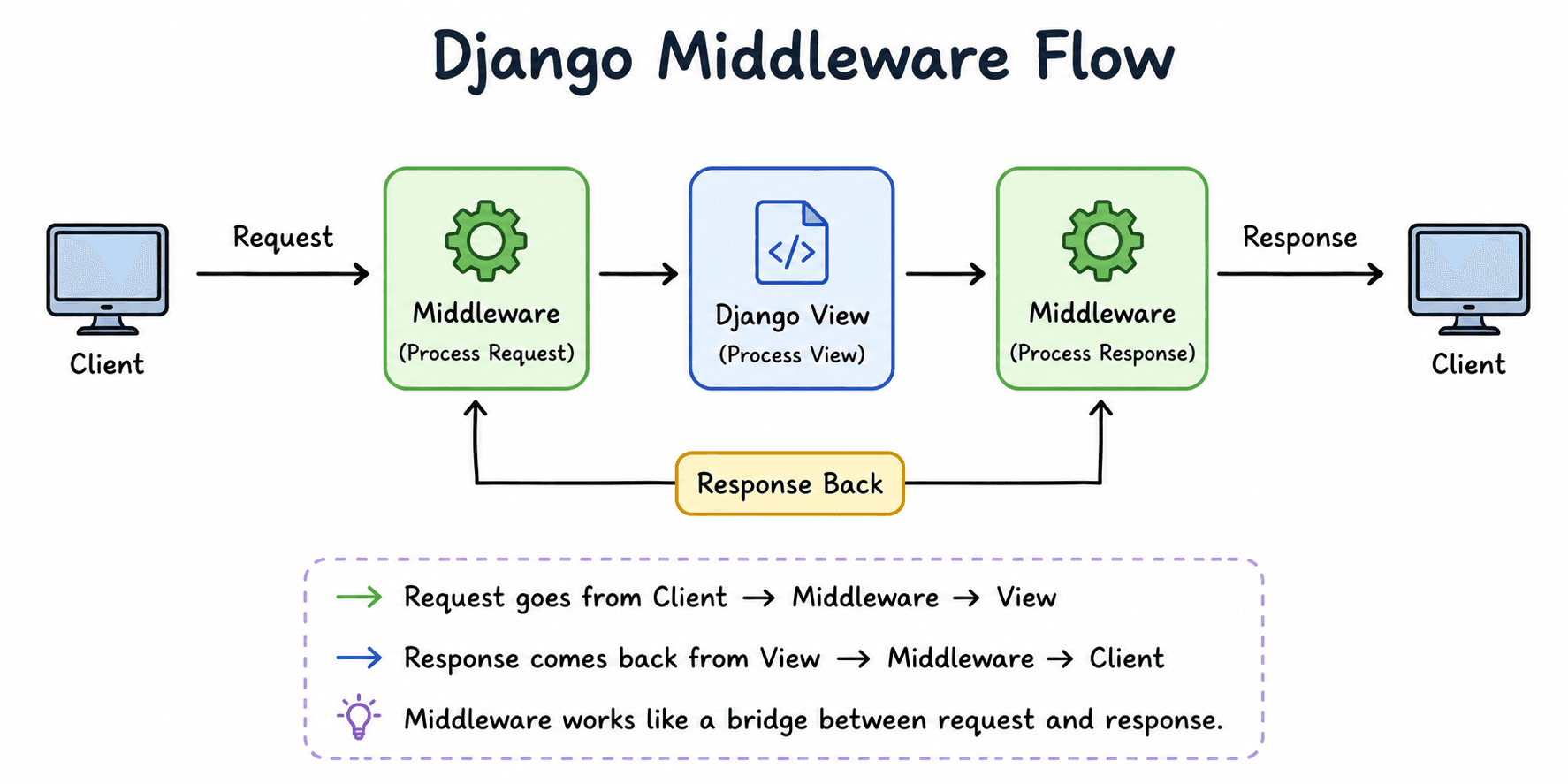
Middleware works like a middle layer between the user’s request and Django’s response.
Basic Flow
Client → Middleware → View → Middleware → Response → Client
For example:
 User
   ↓
 Request
   ↓
 Middleware
   ↓
 Django View
   ↓
 Response
   ↓
 Middleware
   ↓
 User
🤔 What is Middleware?
Middleware is a layer in Django that can process a request before it reaches the view and process a response before it is sent back to the user.
Think of middleware like a security/checking gate.
Before a request enters the application, middleware can check or modify it.
After the view creates a response, middleware can also check or modify that response.
🛠️ What Can Middleware Do?
Middleware can be used for common tasks such as:
- 🔐 Checking authentication
- 🛡️ Security checks
- 📝 Logging requests
- 🍪 Working with cookies and sessions
- ⏱️ Measuring request time
- 🚫 Blocking unwanted requests
- 🔄 Modifying requests or responses
Middleware checks or processes the request before it reaches the view.
🧑💻 Simple Django Example
class MyMiddleware:

    def __init__(self, get_response):
        self.get_response = get_response

    def __call__(self, request):

        print("Request received")

        response = self.get_response(request)

        print("Response sent")

        return response
Here:
request→ information coming from the userget_response→ sends the request to the next part of Djangoresponse→ result returned by the view
So the flow becomes:
Request
   ↓
"MyMiddleware"
   ↓
Django View
   ↓
Response
   ↓
"MyMiddleware"
   ↓
Client
Comments