

#datatypesinpython#python
Data Types in Python – Part 2
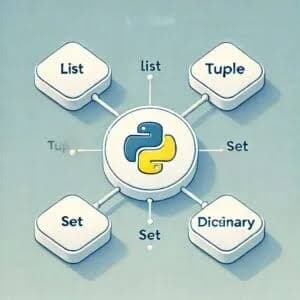
In Part 1, we learned about numeric, string, and Boolean data types. Now let's look at Python's collection data types.
1. List (list)
A list is used to store multiple values in one variable.
fruits = ["apple", "banana", "mango"]

print(fruits)
Output:
['apple', 'banana', 'mango']Lists are ordered and changeable.
2. Tuple (tuple)
A tuple is also used to store multiple values, but its values cannot be changed after creation.
colors = ("red", "green", "blue")

print(colors)
Output:
('red', 'green', 'blue')3. Set (set)
A set stores multiple values and does not allow duplicate values.
numbers = {1, 2, 3, 3}

print(numbers)
Output:
{1, 2, 3}4. Dictionary (dict)
A dictionary stores data using key-value pairs.
student = {
    "name": "Vishnu",
    "age": 21
}

print(student)
Output:
{'name': 'Vishnu', 'age': 21}5. None (NoneType)
None represents no value.
result = None

print(result)
Output:
None
Comments