

#restapi#api#auth
Authorization in Rest API
Authorization in a REST API determines what actions an authenticated user or application can perform on a given resource. While authentication verifies the identity of the user ("who you are"), authorization validates their permissions ("what you are allowed to do"). Because REST APIs are stateless, authorization data must be validated with every single request.
🔑 Common Authorization Strategies
Depending on the complexity of your application, you can implement authorization using several industry-standard models:
- Role-Based Access Control (RBAC): Users are assigned specific roles (e.g.,
Admin,Editor,User). Permissions are mapped to these roles, making it easy to manage broad access levels.
- Attribute-Based Access Control (ABAC): Access is granted based on contextual attributes. This includes user department, time of day, IP address, or object ownership (e.g., only the creator can edit a resource).
- Scope-Based Authorization: Commonly used in OAuth 2.0 flows. Tokens are issued with specific "scopes" (e.g.,
read:profile,write:orders) that restrict the client application's access regardless of the user's maximum permissions.
🛠️ Technical Delivery Methods
Authorization data is typically transmitted from the client to the server via the standard HTTP headers.
1. Bearer Tokens (JWT)
JSON Web Tokens (JWT) are a popular approach for stateless authorization. The token contains signed data (claims) indicating user roles and permissions.
- Header Format:
Authorization: Bearer <token_string>
- How it works: The API decrypts or verifies the digital signature of the token to instantly know the user's permissions without querying a database on every request.
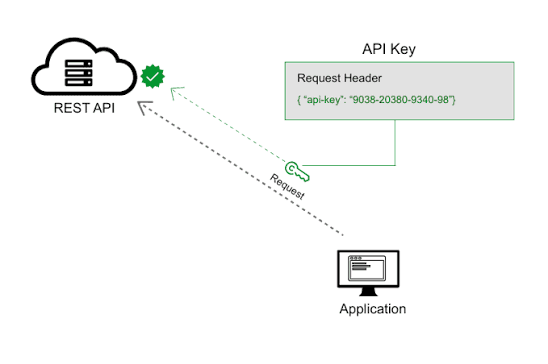
2. API Keys
Mainly used for machine-to-machine communication or third-party developer integrations.
- Header Format:
Authorization: Apikey <key_string>or custom headers likeX-API-Key: <key_string>
- How it works: The server matches the key against an internal registry to identify the application and enforce its configured access limits.
🛡️ Implementation Best Practices
- Always Use TLS (HTTPS): Encrypt your connections to prevent authorization tokens and keys from being intercepted in transit.
- Fail Closed: By default, deny access to all API endpoints unless an explicit authorization rule permits it.
- Return Correct HTTP Status Codes:
- Use
401 Unauthorizedif the request lacks valid authentication credentials. - Use
403 Forbiddenif the identity is verified but the user does not have permission for that specific resource.
- Use
- Validate Token Expiration: Ensure tokens are short-lived to minimize damage if a token is compromised.
- Do Not Pass Tokens in URLs: Avoid passing keys or tokens in query parameters (e.g.,
://example.com) as they leak through server logs and browser histories
Comments