

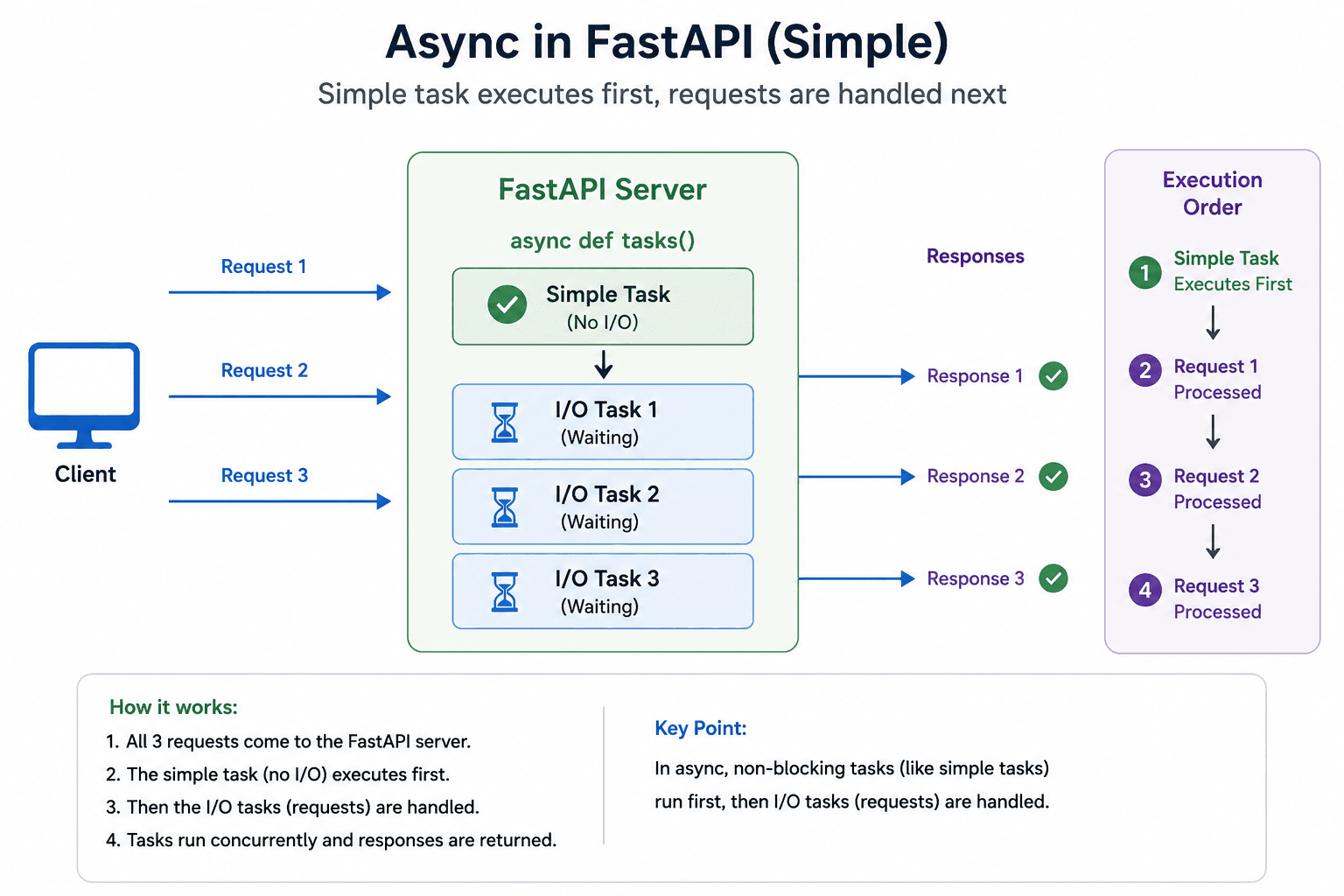
Async Programming in FastAPI
What is Async Programming?
Async programming means a program can start a task and, while waiting for that task to finish, work on another task instead of waiting doing nothing.
In FastAPI, async programming is mainly useful for I/O operations such as API calls, database operations, and reading or writing files.
Work Flow:
Request 1 → Waiting for API
↓
Request 2 → Processing
↓
Request 3 → Processing
↓
Request 1 → API response
Why is Async Important in FastAPI?
FastAPI is designed to handle many requests efficiently. Async programming is especially useful when your application performs I/O operations.
Common I/O operations are:
- Calling another API
- Accessing a database
- Reading files
- Sending network requests
- Calling an AI service
Synchronous Programming
In normal synchronous programming, a task generally waits for the previous task to finish.
Work Flow:
Request 1→Wait→Finish→Request2→Wait→Finish
Example Async code:
from fastapi import FastAPI
app = FastAPI()
@app.get("/")
async def home():
return {"message": "Hello"}
Here:async tells Python that this function is asynchronous.
Comments